Weekly AI visibility review workflow for lean teams
Author: AImpact Team Published: April 6, 2026
TL; DR
- Repeatable weekly workflow for small teams running fast growth loops.
- Winning teams review AI visibility weekly and tie insights to content and conversion decisions.
- You need both search performance and AI recommendation tracking to avoid discovery blind spots.
- A clear dashboard and operating cadence beats one-off reporting.
Introduction
B2B SaaS buyers are no longer discovering products only through search results. They also discover tools through AI-generated recommendations. That shift means teams need better systems for measuring and improving visibility.
This guide on weekly ai visibility workflow gives you a practical framework you can implement without a large team. The goal is simple: translate AI visibility movement into actions that increase qualified demand.
If you want a baseline before you implement, start with AImpact's AI visibility platform and map your current position against competitors.
Framework
1. Define the decision you need to make
Before collecting metrics, define the decision outcome:
- Which content should we publish next?
- Which pages need refresh work now?
- Where are competitors outperforming us in AI mentions?
Without a clear decision goal, dashboards become noise.
2. Track the minimum KPI set
For most teams, the minimum weekly metrics are:
- Mention frequency by model
- Citation quality by source domain
- Share of voice vs top competitors
- Conversion actions from BOFU content paths
These four metrics provide enough signal to prioritize work.
3. Map findings to execution
Each insight should produce a concrete action:
- Low mention rate on commercial prompts -> publish/update comparison content
- Weak citation quality -> improve source authority and page structure
- Declining share of voice -> refresh cluster pages and tighten internal links
Use AImpact features and dashboard views to keep this loop visible to the team.
Step-by-step implementation
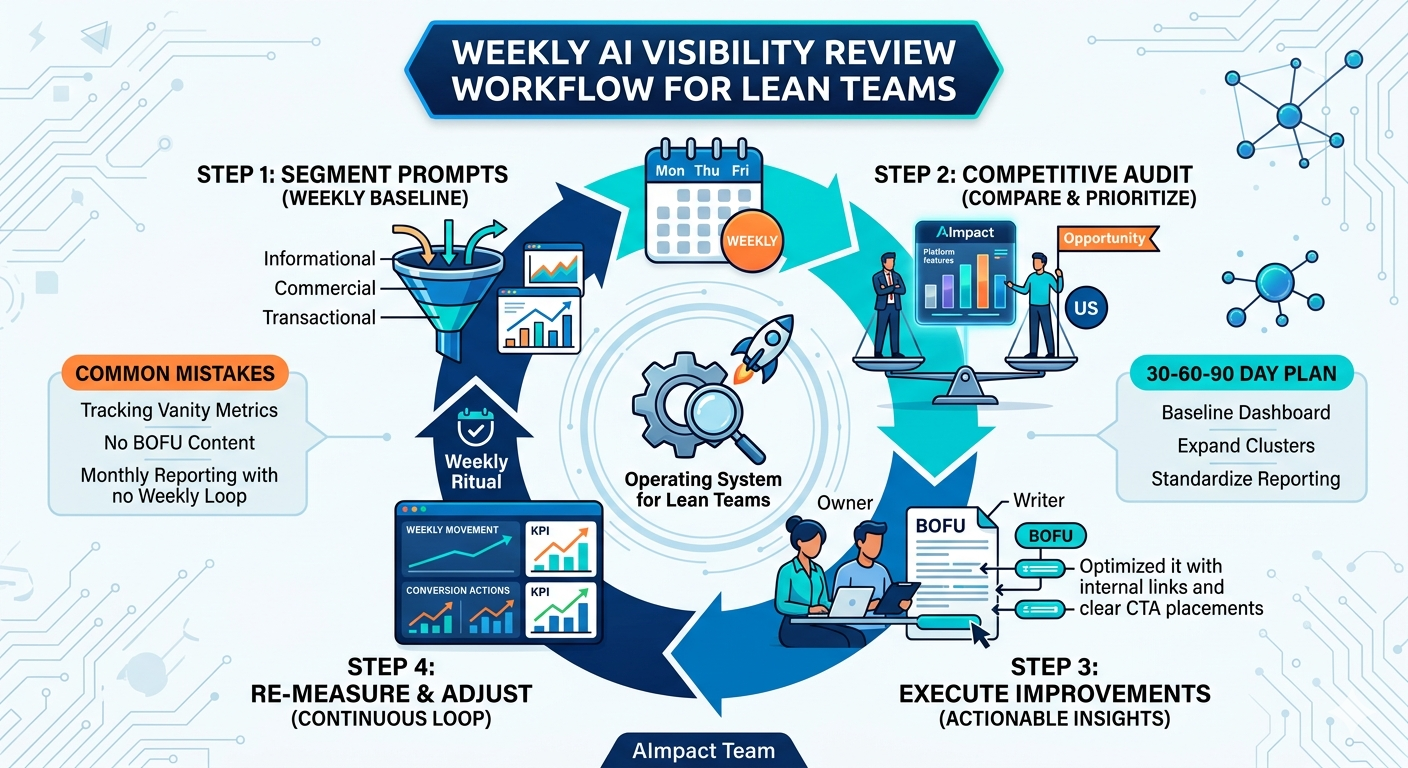
- Collect one week of baseline prompt and mention data.
- Segment prompts by informational, commercial, and transactional intent.
- Compare your visibility with three to five competitors.
- Prioritize top five opportunities by impact and effort.
- Publish two focused improvements each week.
- Re-measure and document movement in a shared report.
This cycle keeps teams moving without overcomplication.
Common mistakes
Mistake: tracking too many vanity metrics
Teams often collect broad performance data that does not change decisions. Keep your stack small and action-oriented.
Mistake: ignoring model-level differences
Performance varies across ChatGPT, Claude, Gemini, and other models. Track by model so you can spot specific gaps.
Mistake: no BOFU content path
Even with strong visibility, conversions lag if readers cannot move from insight to action. Include clear BOFU pathways and CTA placements.
Mistake: monthly reporting with no weekly loop
By the time monthly reports arrive, opportunities are stale. Use weekly review cycles and monthly strategy updates.
30-60-90 day operating plan
Days 1-30
- Build baseline dashboard
- Publish one foundational and one BOFU asset
- Set review ritual with clear ownership
Days 31-60
- Expand into cluster support content
- Refresh high-opportunity URLs
- Improve CTA placement and internal linking
Days 61-90
- Standardize reporting cadence
- Compare quarter-over-quarter visibility trend
- Tie visibility movement to pipeline metrics
For budget planning and conversion path design, refer to AImpact pricing.
Conclusion
Weekly AI visibility review workflow for lean teams should not be treated as a one-time project. It is an ongoing operating system that helps growth teams ship better content and capture more qualified demand.
If you want a clear baseline and action plan, use this next step: book a free 30-minute AI audit.
FAQ
Q: How quickly can teams see movement? Most teams see directional changes in two to six weeks when they execute weekly improvements.
Q: Should this replace SEO reporting? No. AI visibility and SEO reporting work together and should be reviewed in one decision cycle.
Q: What is the minimum team setup? One owner, one writer, and one reviewer is enough to run this workflow effectively.
Q: What cadence works best? Weekly operational reviews plus monthly strategic adjustments is the most practical model.
Q: What should the CTA be? Use a low-friction action tied to measurable value, such as an audit or trial.
CTA
Get your benchmark and next-step plan: Get your free AI visibility report