How AI models decide which brands to mention
Author: AImpact Team Published: April 6, 2026
TL; DR
- Explains ranking signals, citation behavior, and how to influence model outputs with better content.
- High-performing teams track both search rankings and AI recommendation visibility.
- A practical operating cadence beats one-off analysis.
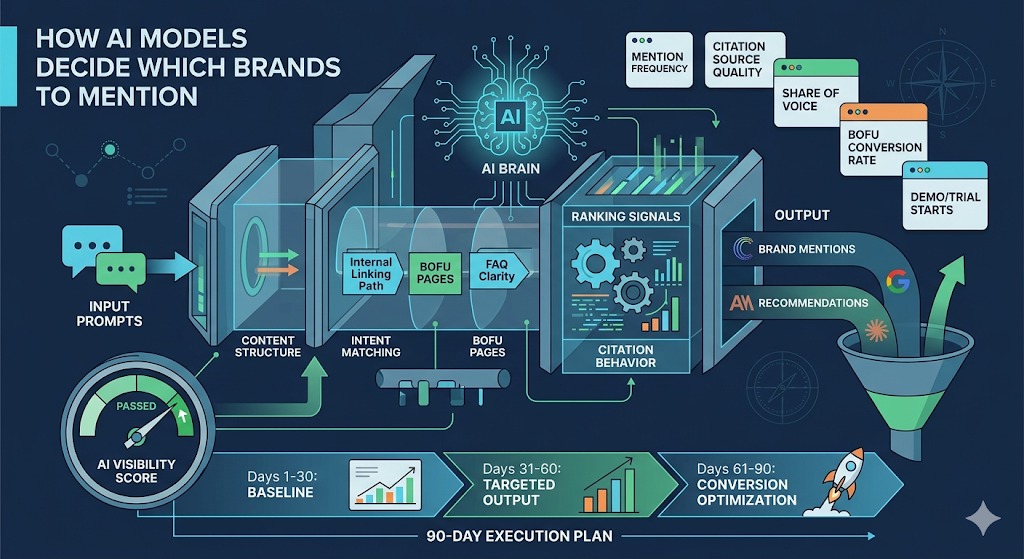
- The fastest wins come from better structure, clearer intent matching, and stronger BOFU pages.
- Every article should end with a measurable next action.
Why this matters now
Most B2B SaaS teams still run growth with an SEO-only dashboard. That is no longer enough. Buyers now ask ChatGPT, Claude, and Gemini for recommendations before they click a traditional result.
If your brand is not showing up in those responses, you are losing demand before your website gets a chance to convert it. This is where how ai models choose brands becomes a growth priority, not just a reporting metric.
In our work with early-stage and scaling SaaS teams, the pattern is consistent: teams that measure AI visibility weekly make faster decisions and ship better content. Teams that wait for quarterly reporting lose momentum.
Core framework
1) Define one outcome metric
Pick one primary outcome for the next 90 days:
- More demo requests from organic and AI-assisted channels
- More trial starts from BOFU pages
- Higher share of AI model recommendations for core category prompts
When teams track too many objectives, execution slows down. One primary outcome keeps prioritization clean.
2) Map prompts and keywords by intent
Your discovery strategy should include both keyword and prompt mapping:
- Informational intent for category education
- Commercial intent for comparisons and alternatives
- Transactional intent for implementation and product-fit decisions
Create one content asset for each intent bucket every week. This improves coverage and reduces blind spots.
3) Build an internal linking path that converts
Internal links should move readers forward:
- Educational post -> feature explanation
- Feature explanation -> dashboard or pricing context
- Final step -> audit or trial CTA
Use these links consistently:
4) Track weekly, optimize monthly
A working cadence for lean teams:
- Weekly: mention rate, citation quality, prompt coverage
- Monthly: content refreshes, title/CTR improvements, CTA adjustments
- Quarterly: cluster expansion and comparison page upgrades
This rhythm prevents stale content and keeps the strategy tied to output.
90-day execution plan
Days 1-30: establish baseline
- Define target prompts and competitor set
- Publish one foundational guide and one BOFU page
- Set initial baseline for model mention rate and citation quality
Days 31-60: scale targeted output
- Publish two intent-matched posts per week
- Add one benchmark or data-backed post
- Tighten internal links and FAQ structure for AI readability
Days 61-90: optimize for conversion
- Refresh top five URLs by opportunity
- Improve low-CTR pages with better titles and intros
- Add stronger contextual CTAs within first 500 words
Common mistakes to avoid
- Measuring traffic without measuring recommendation visibility
- Publishing only TOFU content while BOFU pages stay thin
- Ignoring model-specific behavior differences
- Treating reporting as analysis instead of action
- Failing to connect content metrics to pipeline outcomes
KPI stack
Track these metrics every week:
- AI model mention frequency
- Citation source quality
- Share of voice by model
- BOFU page conversion rate
- Demo or trial starts from content paths
Then review monthly for strategic changes.
Conclusion
How AI models decide which brands to mention is not a one-time tactic. It is an operating discipline. Teams that treat AI visibility as a weekly decision system gain compounding advantage in discovery.
If you want an exact baseline and next-step plan for your category, start here: book a free 30-minute AI audit.
FAQ
Q: How quickly can teams see improvement from this approach? Most teams see directional movement in 2-6 weeks when they run a weekly tracking cadence and publish intent-matched assets.
Q: Should small teams prioritize SEO or AI visibility first? Use both from day one. SEO captures classic demand; AI visibility captures recommendation demand.
Q: How many posts per month are enough? For most lean teams, four to eight high-quality posts with BOFU coverage is a strong baseline.
Q: What is the biggest blocker to results? Lack of prioritization. Teams publish consistently but without a clear conversion path.
Q: What should the CTA be on these posts? Use a direct, low-friction action tied to your product, such as a free audit or trial.
CTA
Get your benchmark and action plan: Get your free AI visibility report