Content marketing strategies for B2B SaaS: a practical 90-day plan
Author: AImpact Team, Founder Office Published: April 6, 2026
TL; DR
- Most B2B SaaS teams do not fail from a lack of content. They fail from a lack of content priorities.
- Your strategy should map content to funnel stage, revenue goal, and one measurable KPI per asset.
- A high-performing mix is simple: TOFU demand capture, MOFU proof content, BOFU conversion pages.
- You should now optimize for two discovery systems: classic search and AI model recommendations.
- A 90-day sprint with strict weekly output can produce pipeline impact without a large team.
Table of contents
- What good content marketing means for B2B SaaS in 2026
- Build your B2B SaaS content strategy around funnel stages
- 7 content marketing strategies for B2B SaaS that drive pipeline
- A 90-day execution plan for lean B2B SaaS teams
- KPI dashboard to prove content ROI
- Common mistakes that kill content performance
- Tool stack and workflow for small teams
- Conclusion
- FAQ
If your team publishes weekly and still cannot connect content to pipeline, you are not alone. This is exactly why content marketing strategies for B2B SaaS need to be built as an operating system, not a random editorial calendar.
Most teams track page views, celebrate ranking jumps, and then wonder why demo volume stays flat. The fix is not "more blogs." The fix is priority, structure, and measurement.
In this guide, you will get a practical framework to decide what to publish, how to sequence it, and how to prove it worked. You will also see how to combine SEO and AI visibility, because buyers now discover products in both places.
Ready to benchmark where you stand in AI discovery right now? Get your free AI visibility report: book a free 30-minute AI audit
What good content marketing means for B2B SaaS in 2026
"Good content" in B2B SaaS is not content that sounds smart. It is content that moves a buyer one step closer to a decision.
That means every asset needs three things:
- A clear audience and buying stage
- A measurable business goal
- A planned path to the next action
In practice, this changes how you brief writers and how you judge performance. A top-of-funnel guide can be great for category demand and still be weak for conversions. A comparison page can have less traffic and still drive more qualified demos.
There is also a second shift: buyers now ask ChatGPT, Claude, and Gemini for tool recommendations before they click through a traditional search result. If your strategy only tracks rankings and ignores model mentions, you miss a growing part of discovery.
For B2B SaaS teams, the core objective is simple:
- Build authority in your category
- Capture high-intent demand with BOFU pages
- Convert attention into pipeline with clear next steps
Everything else is execution detail.
Build your B2B SaaS content strategy around funnel stages
Strong SaaS programs split output across TOFU, MOFU, and BOFU. Weak programs overinvest in TOFU and then complain that content "does not convert."
TOFU: demand capture and awareness
TOFU content targets broad problems your ICP already feels.
Examples:
- "How to reduce customer churn in SaaS"
- "GEO vs SEO for startup growth teams"
- "What is AI visibility and why it matters"
Goal:
- Earn visibility
- Build trust
- Bring new qualified traffic
Primary KPIs:
- Impressions
- New users
- Non-branded ranking growth
MOFU: proof and problem framing
MOFU assets help buyers evaluate approaches. This is where strategy frameworks, benchmarks, and practical templates perform best.
Examples:
- "B2B SaaS onboarding content framework"
- "How to build an AI visibility scorecard"
- "Content audit template for Series A SaaS"
Goal:
- Build buying confidence
- Move prospects to active evaluation
Primary KPIs:
- Engaged sessions
- Return visitors
- Lead magnet conversion
BOFU: conversion intent
BOFU content is where pipeline usually comes from. It includes alternatives pages, use-case pages, integrations, and implementation guides.
Examples:
- "AImpact vs Profound"
- "How growth teams use AImpact to track competitor mentions"
- "AI visibility dashboard setup checklist"
Goal:
- Reduce friction
- Increase trial or demo intent
Primary KPIs:
- Trial starts
- Demo requests
- Sales-qualified leads
Quick rule: If your monthly output is 80% TOFU, pipeline impact will lag. A better mix for most B2B SaaS teams is 40% TOFU, 35% MOFU, and 25% BOFU.
7 content marketing strategies for B2B SaaS that drive pipeline
This is the practical core of the plan. Use these strategies as your execution checklist.
1) Build topic clusters around ICP pain points
Start with three to five pain-point clusters, not random keywords. For AImpact, example clusters include AI visibility, GEO strategy, answer engine optimization, and model-specific optimization.
Each cluster should include:
- One pillar page
- Four to eight supporting posts
- One comparison or BOFU page
This creates internal relevance and helps buyers move deeper without leaving your site.
You can reinforce this with strategic internal links to AImpact's AI visibility platform and full feature list.
2) Publish comparison and alternatives content early
Many teams wait too long to create alternatives pages. That is a mistake. Buyers with commercial intent actively search for alternatives and comparison queries.
High-intent examples:
- "Profound alternative"
- "Otterly vs [your product]"
- "Best AI visibility tools for startups"
Comparison content should stay factual, specific, and measurable. Keep claims tied to features, model coverage, speed to setup, and pricing.
3) Use data-backed benchmark posts
Benchmark posts build authority fast when they include clear methodology. Even small datasets can perform if the insight is useful.
Mini-story 1:
In January 2026, Priya, a solo founder running a B2B SaaS analytics tool, published a benchmark across 120 AI prompts in her category. The post was not flashy. It included a simple table: brand mention rate, citation source quality, and week-over-week change. Within six weeks, the post became her highest-converting page, producing 14 demo requests from fewer than 2,000 visits. The leverage came from clarity, not volume.
If you publish benchmarks, include:
- Date range
- Sample size
- Exact prompt or query framework
- Limits of the dataset
4) Build product-led educational content
Your best educational content should show the work, not just describe the concept.
Example:
- Instead of "How to track AI visibility," publish "How to track AI visibility in 30 minutes with a weekly dashboard cadence."
Then walk readers through setup logic, KPI definitions, and action loops. Link naturally to the AImpact dashboard when discussing workflow execution.
5) Design every article for dual discoverability (SEO + AI recommendations)
B2B SaaS teams now need content that performs in both systems:
- Search engine ranking
- AI model citation or recommendation
Practical formatting that helps both:
- Answer the core query in the first 200 words
- Use descriptive question-style H2s where appropriate
- Add concise definitions and comparison tables
- Keep FAQ sections at the end for retrieval clarity
6) Create a distribution engine, not one-off promotion
A post without distribution is incomplete work.
For each article:
- Publish full post on blog
- Repurpose into one email
- Repurpose into three social posts
- Pull one chart or quote card
- Add one founder commentary post
Mini-story 2:
In March 2026, Marco led growth at a 12-person SaaS company. His team published two strong BOFU pages, then did almost no distribution. Results were flat. In April, they kept the same content volume but added a fixed distribution cadence: one email send, three LinkedIn variants, and one founder breakdown thread. Click-through to BOFU pages rose from 1.1% to 3.8% in four weeks, and trial starts doubled from 9 to 18.
7) Run monthly content refresh cycles
New content matters, but refreshes are often faster ROI. For each month, pick three existing URLs and update:
- Outdated stats
- Weak intros
- Missing internal links
- Thin sections that do not answer intent
Link refreshes to your core conversion pages such as AImpact pricing and your final CTA path.
A 90-day execution plan for lean B2B SaaS teams
This plan assumes a small team and one owner accountable for output.
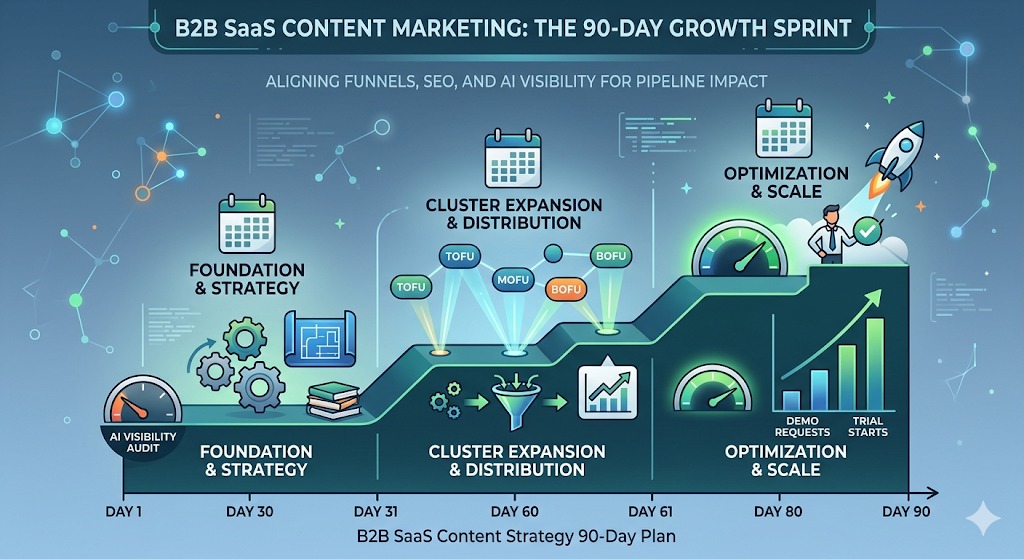
| Phase | Focus | Weekly output | Success signal |
|---|---|---|---|
| Days 1-30 | Strategy and quick wins | 1 TOFU, 1 BOFU, refresh 1 post | Faster indexing, early conversion lift |
| Days 31-60 | Cluster expansion | 2 MOFU, 1 BOFU per week | More qualified sessions, higher return rate |
| Days 61-90 | Optimization and scale | Refresh 2 posts, publish 2 priority assets | Pipeline influence becomes visible |
Days 1-30: establish structure
Deliverables:
- Keyword and query map by funnel stage
- Cluster architecture
- Two BOFU pages live
- One dashboard for KPIs
Do not overbuild tooling in this phase. Execution speed matters more.
Days 31-60: add depth and proof
Deliverables:
- Six to eight new pieces, weighted to MOFU and BOFU
- One benchmark or original insight post
- Weekly distribution rhythm
This is where you start seeing measurable movement in engagement quality.
Days 61-90: optimize what already works
Deliverables:
- Refresh high-potential URLs
- Improve internal linking paths
- Update meta titles and descriptions based on CTR trends
- Tighten CTAs on high-traffic pages
Mini-story 3:
A B2B SaaS team at 40 employees had a large library but weak conversion. In one quarter, they paused low-intent publishing, refreshed eight existing posts, and added BOFU CTAs aligned to use case pages. Organic traffic rose only 11%, but demo requests from blog pages increased 46%. They learned the right lesson: quality of intent beats raw volume.
KPI dashboard to prove content ROI
A practical dashboard should be small and decision-ready. Track three tiers.
Leading indicators
- Non-branded impressions
- Ranking growth for target clusters
- AI model mention frequency
- Citation quality trend
Mid-funnel indicators
- Engaged sessions by content type
- Scroll depth on pillar pages
- Email signups from content
- Repeat visits within 30 days
Revenue indicators
- Trial starts from content paths
- Demo requests from BOFU pages
- SQL rate from content-sourced leads
- Pipeline influenced by content touchpoints
You can monitor AI-facing visibility and competitor gaps with multi-model AI tracking and use that to prioritize what to publish next.
Common mistakes that kill content performance
Mistake 1: publishing without a decision model
If every topic feels equally important, your pipeline will stall. Score topics by business intent, competitive difficulty, and execution effort.
Mistake 2: writing for keywords, not buyers
Keyword fit matters, but buyer intent is the priority. If a page does not solve a real decision problem, ranking alone will not convert.
Mistake 3: no BOFU content until "later"
Later usually means never. BOFU content must be part of month one.
Mistake 4: weak internal linking architecture
Posts should pass readers to the next best step. Link intentionally:
- Educational -> framework
- Framework -> comparison
- Comparison -> CTA
Mistake 5: no AI visibility measurement
Traditional SEO reports do not tell you if AI models recommend your brand. If you do not measure mentions, citation quality, and share of voice, you miss real buying signals.
Tool stack and workflow for small teams
Most early-stage teams need simple tooling and rigid cadence.
Minimum viable stack
- Keyword research tool for baseline demand
- Content calendar and briefing template
- Analytics and attribution setup
- AI visibility monitoring workflow
Weekly operating rhythm
- Monday: prioritize one TOFU, one MOFU, one BOFU candidate
- Tuesday-Wednesday: produce and edit
- Thursday: publish + distribute
- Friday: review performance and decide refreshes
A system like this is sustainable with a small team. It also compounds fast.
When you are ready to benchmark performance and identify blind spots, start with AImpact's AI visibility platform and close the loop with a tailored audit.
Conclusion
The best content marketing strategies for B2B SaaS are practical and measurable. They do not depend on a giant team, and they do not rely on guesswork.
If you map output by funnel stage, prioritize BOFU early, and measure both search and AI visibility, your content starts behaving like a growth system. That is the shift most teams need.
Your next move is simple: run a 90-day sprint, publish with intent, and review weekly using one KPI dashboard.
When you want an outside view of where your visibility gaps are, get your free audit here: Get your free AI visibility report
FAQ
Q: What is the best content mix for B2B SaaS? A practical starting point is 40% TOFU, 35% MOFU, and 25% BOFU. The exact mix depends on your stage and pipeline goals, but most teams underinvest in BOFU early.
Q: How long does B2B SaaS content marketing take to show ROI? You can see early leading indicators in 30 to 60 days, especially for engagement and ranking movement. Pipeline impact usually becomes clearer over a 90-day cycle when BOFU assets are included.
Q: Should B2B SaaS teams prioritize SEO or AI visibility? You should prioritize both. SEO captures search demand, while AI visibility affects recommendation-based discovery in tools like ChatGPT and Claude.
Q: How many articles should a lean SaaS team publish each month? Start with consistent quality over volume. A strong baseline is four to eight strategic assets per month, with at least two tied to commercial intent.
Q: What should I track to prove content is working? Track a layered KPI set: impressions and rankings, engagement quality, and conversion outcomes like trials, demos, and pipeline influence.
SEO checklist
- [x] Primary keyword in H1
- [x] Primary keyword in first 100 words
- [x] Primary keyword variation in multiple H2 headings
- [x] 3-5 internal links included
- [x] 2-3 external authority links included
- [x] Meta title 50-60 characters
- [x] Meta description 150-160 characters
- [x] Proper H1/H2/H3 hierarchy
- [x] FAQ section included for AEO readability
CTA block
If AI models are not mentioning your brand yet, that is fixable. Start with a baseline and a clear action plan: book a free 30-minute AI audit